4. Third person (singular)
| lloc: | Institut Escola El Pi Gros |
| Curs: | 6è Primària |
| Llibre: | 4. Third person (singular) |
| Imprès per: | Usuari convidat |
| Data: | dimecres, 30 de setembre 2026, 09:09 |
Descripció
3rd person singular (He, she, it)
THIRD PERSON (Singular: HE,SHE,IT)
Normally in the present tense we add S to the end of the verb in the third person ( HE / SHE / IT)
speak speaks
pay pays
drink drinks
hate hates
Examples:
I drink water She drinks water
We hate running He hates running
NEGATIVE
Remember we must use the verb to do . In the third person does.
I don't like running
She doesn't like singing

SPELLING RULES
If the verb ends in SS , X , CH , SH ,or the vowel O .
· miss + es = misses He misses her so much.
· watch + es= watches She watches TV
· go + goes He goes to school
If the base form ends in consonant + Y remove the -Y and add –IES
· carry --> carries Tom carries his backpack
· worry --> worries My father worries about me.
· study --> studies She studies English

IRREGULAR VERBS
· be --> is He is a boy ( You cannot say bes!)
· have --> has She has a dog ( You cannot say haves!)
MODAL VERBS
Such as can, must, should, may and might, do not take -s in the third person singular present because, modal verbs do not take endings at all.
· She can speak three languages.
He must like football a lot
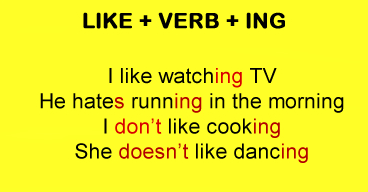
"LIKE" + VERB + ING
We can use LIKE / LOVE / HATE and DON'T MIND to say how we feel about an activity.
Other verbs are: enjoy, dislike, can't stand
We are using a verb as a noun when we are talking about an activitiy.
I like oranges I like dancing ( not I like to dancing)
Exemples:
I like watching TV in the afternoon
He hates cooking
She loves listening to music